Patients are asking about GLP-1. They see it in the news, hear about it from friends and bring it up before you even raise the topic. Many want metabolic support without starting injectable pharmaceutical GLP-1 therapies or managing the side effects that can come with them. That demand has sent patients searching for natural pathways to metabolic support, and it has probably reached your inbox, too.
The research exists. Berberine’s relationship with Akkermansia muciniphila and its downstream connection to gut-derived GLP-1 activity is evident across the preclinical literature. No single resource connects these threads into something you can use at the point of care. The mechanisms warrant closer examination so you can evaluate this combination for cardiometabolic and weight-management protocols with confidence.
Two Mechanism Threads, One Clinical Opportunity
Berberine and Akkermansia muciniphila connect to GLP-1 pathway activity through two separate threads of research:
- Berberine enriches Akkermansia muciniphila: Berberine enhances Akkermansia growth in the gut, a shift researchers identified as central to berberine’s broader metabolic benefits.
- Akkermansia stimulates GLP-1 secretion: Once enriched, Akkermansia triggers a sharp rise in GLP-1 secretion through its own signaling mechanisms.
Together, these threads describe one connected system worth evaluating as a whole.
Patients with type 2 diabetes and obesity tend to show measurably reduced Akkermansia abundance, and restoring it may support the body’s own GLP-1 production rather than replace pharmaceutical GLP-1 receptor agonists. That difference matters for any practitioner evaluating berberine-Akkermansia interactions in a cardiometabolic protocol. The clinical opportunity lies in addressing microbiome composition and incretin signaling through a single formulation decision.
Berberine’s Prebiotic Effect on Akkermansia
The berberine mechanism of action in the gut is indirect. Berberine does not stimulate Akkermansia growth on contact. Instead, it changes the host environment first, and Akkermansia responds to that shift over time.
The first mechanism involves bile acid signaling. Berberine inhibits adenosine monophosphate-activated protein kinase (AMPK) activity in this specific metabolic context. That inhibition upregulates cholesterol 7 alpha-hydroxylase (CYP7A1), the rate-limiting enzyme that converts cholesterol into bile acids, and the resulting shift in bile acid metabolism correlates with increased Akkermansia abundance in preclinical models. Researchers have observed this pattern across multiple rodent studies using varied berberine doses.
The second mechanism runs through mucin production. Berberine significantly upregulates Mucin 2 (MUC2) and other mucin-producing genes. This upregulation increases colonic mucin secretion, and Akkermansia depends on that mucin layer as its primary nutrient substrate. More mucin production simply creates more room for the bacterium to proliferate and establish itself.
Berberine functions less like a direct antimicrobial and more like a selective upstream prebiotic. It sets the gut environment before Akkermansia’s GLP-1 activity even begins. Current research on berberine and the gut microbiome frames this relationship as host-mediated rather than direct, and the connection between berberine and gut bacteria depends on that distinction holding up under further study. The evidence remains emerging, and most data still comes from preclinical models rather than completed human trials.
Akkermansia Muciniphila and GLP-1 Secretion
Akkermansia muciniphila secretes a protein called P9, also known as Amuc_1631. This protein binds to the intercellular adhesion molecule 2 (ICAM-2) receptors on intestinal L-cells, and this binding triggers calcium-dependent signaling that directly leads to GLP-1 secretion. Researchers observed this GLP-1 response in NCI-H716 cells, where GLP-1 output rose sharply after exposure, alongside modest increases in insulin secretion in INS-1 cells from the same study.
Akkermansia muciniphila may also support the broader metabolic environment tied to GLP-1 activity. Current research links Akkermansia muciniphila to intestinal barrier integrity, modulation of inflammation and broader metabolic signaling. However, the clearest GLP-1-specific mechanism in the current source is the P9/ICAM-2 pathway described above.
This activity does not activate GLP-1 receptors directly. Akkermansia supports the body’s own endogenous GLP-1 production instead. This distinction separates the mechanism entirely from GLP-1 receptor agonist medications, and most evidence for this mechanism comes from in vitro and preclinical models. Human validation remains ongoing across several research groups.
One emerging hypothesis works in the opposite direction. GLP-1 therapies may increase Akkermansia abundance over time, which raises the possibility of a self-reinforcing loop between the two mechanisms. Direct clinical validation has not yet occurred, so this loop remains firmly in hypothesis territory for now.
The Downstream Metabolic Effects
These two mechanism threads connect to outcomes practitioners already track closely, including:
- Insulin sensitivity: Research on berberine insulin sensitivity shows measurable improvements in fasting glucose and lipid panels across preclinical models.
- Glucose regulation: Akkermansia insulin resistance research points to similar improvements tied to restored intestinal barrier integrity and reduced systemic inflammation.
- Combined impact: Berberine and Akkermansia function as natural insulin sensitizers on their own, but the evidence for pairing them tells a more complete story.
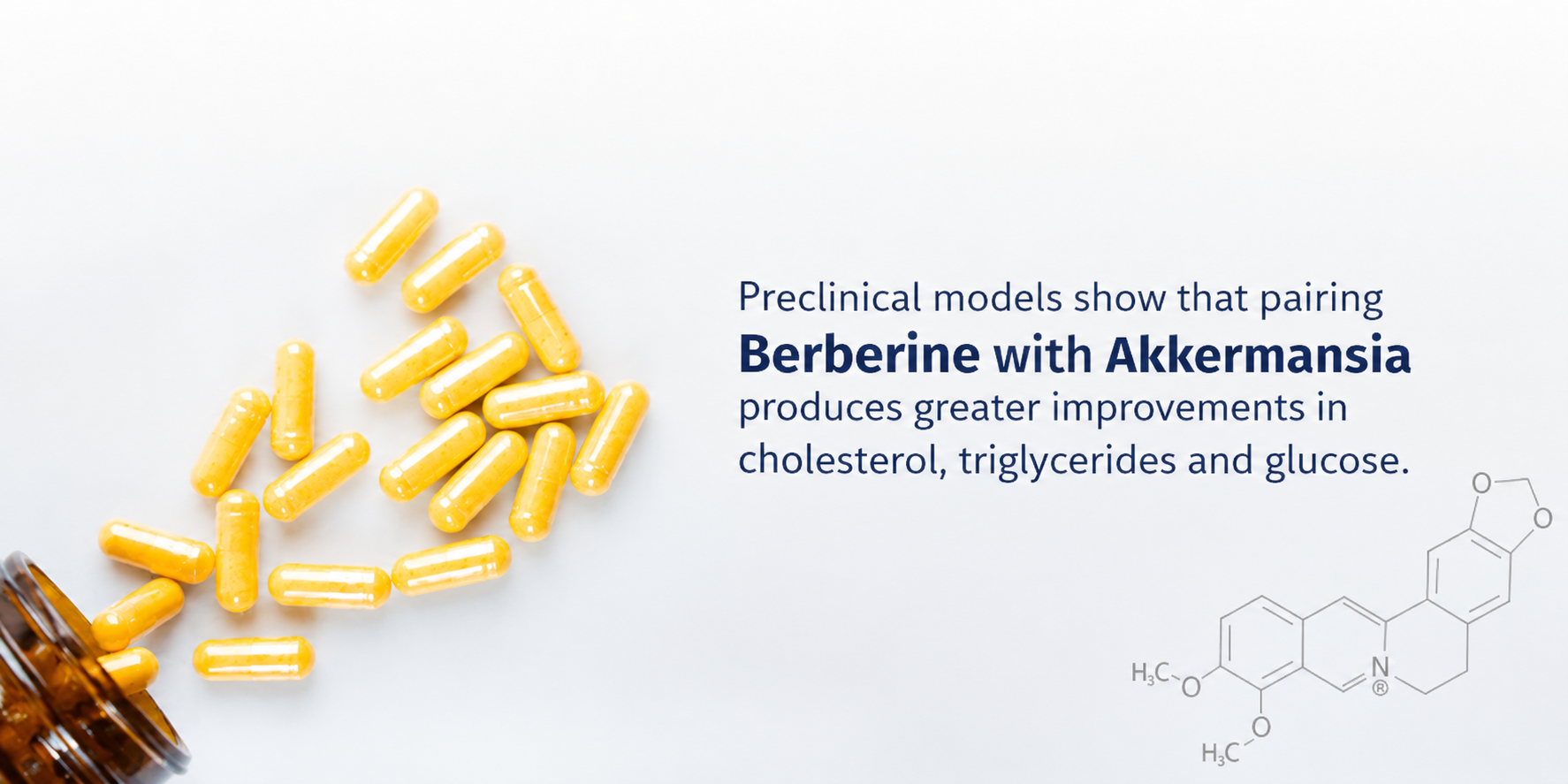
Preclinical models show that pairing berberine with Akkermansia produces greater improvements in cholesterol, triglycerides and glucose than either ingredient achieves solo, along with favorable shifts in hepatic markers across the same study population. For patients managing metabolic syndrome where berberine is under consideration, the combined signal carries more clinical weight than a single-marker improvement. Human clinical validation is ongoing, and no data suggest that this combination outperforms or replaces pharmaceutical GLP-1 therapies on any measured outcome.
Protocol Considerations for Practitioners
Preclinical dosing for berberine and Akkermansia varies by study design, delivery method and the specific outcome researchers measured. This means no single milligram figure applies across the board. That variability is exactly why a formulation decision benefits from practitioner judgment rather than a fixed number pulled from a single trial.
Combining berberine and Akkermansia into a single consolidated formula reduces two separate mechanistic threads to a single formulation decision. A patient managing metabolic syndrome or early insulin resistance already faces a heavy pill count most days, and two more direct-to-consumer bottles can compound that burden. Fewer bottles likely means an easier regimen to stick with, even without a formal compliance study to point to.
This approach works best for patients who fit any of the following profiles:
- Patients managing metabolic syndrome.
- Patients with early insulin resistance.
- Patients showing active interest in the natural GLP-1 pathway support they have already read about.
Custom Formulations With Personalized Nutrients
Building this combination into a protocol should not mean two separate bottles and two separate schedules for a patient to track. Pill fatigue takes a real toll on compliance, and every added bottle makes follow-through less likely.
Many practitioners already turn to custom Berberine formulations as a stand-alone option for metabolic support. Just as many explore Akkermansia muciniphila formulation options on their own.
Personalized Nutrients supports a more consolidated formulation approach. Its cloud-based formulator puts dosing decisions in your hands, letting you combine berberine and Akkermansia muciniphila into one personalized supplement formula built by practitioners, not pulled off a shelf. You choose the ratios. You choose the doses. Your patient gets one bottle instead of two.
Contact Personalized Nutrients to schedule a free consultation today.